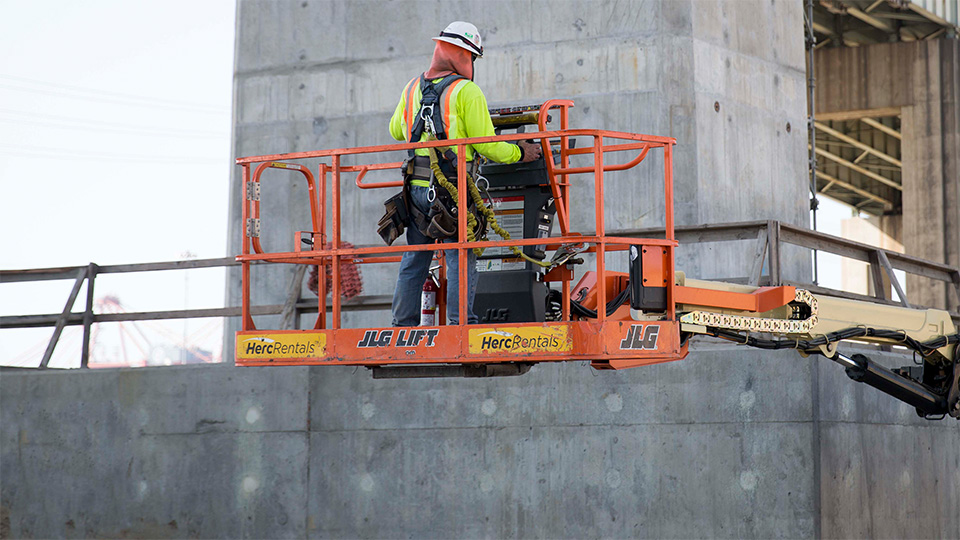
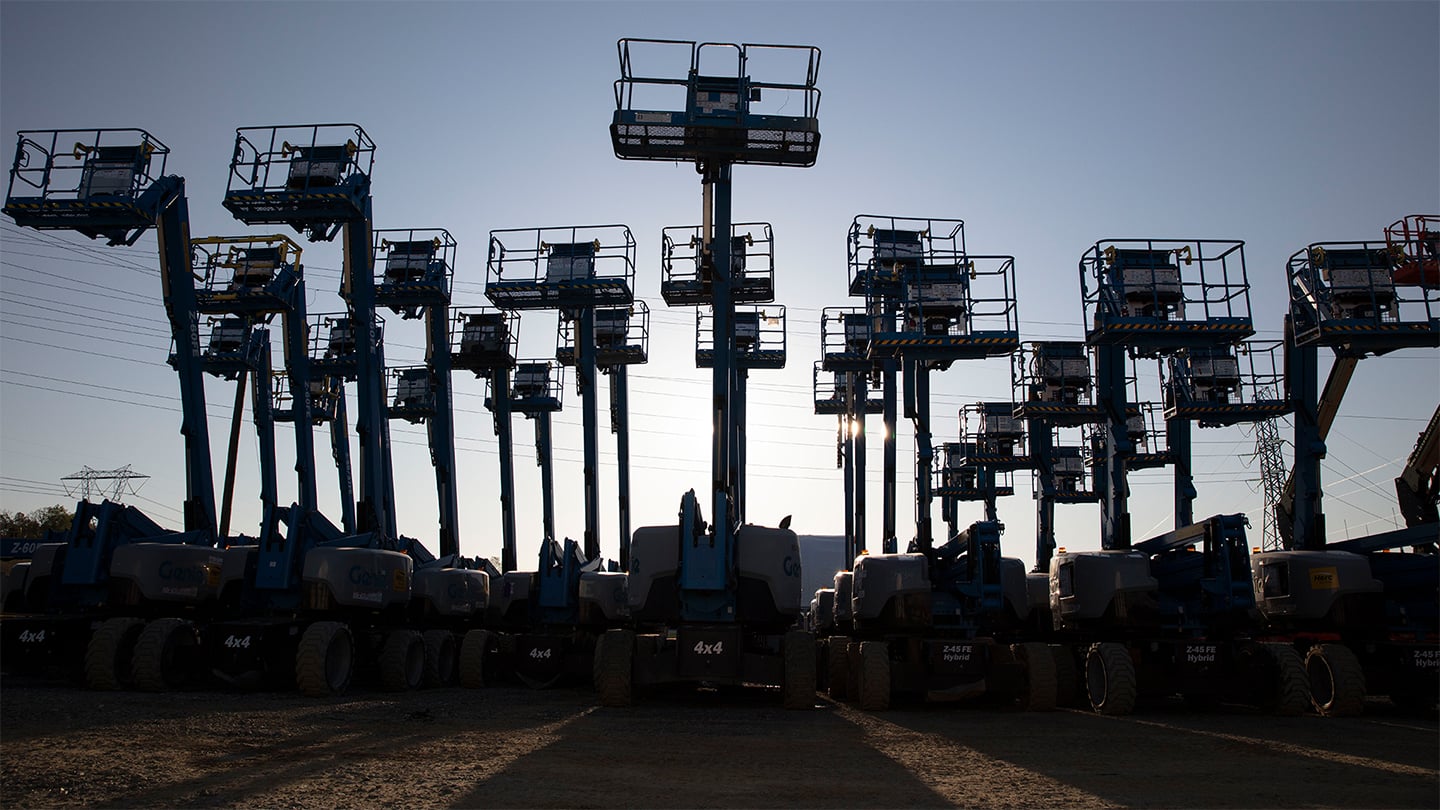
On any project site, whether it’s the construction of a large manufacturing plant or a small office remodel, you’ll run into tasks that require safe, steady access to high or awkward-to-reach places. That’s where construction aerial lifts come in.
With the right lift, you can elevate your crew and your project’s objectives. From carrying workers and materials to places that ladders can’t reach to maneuvering around a project site efficiently and safely, aerial lifts can make all the difference. In this guide, you’ll learn what types of construction lifts you can use at your worksite and how to make sure you rent the best lift for your needs.
What Is an Aerial Lift, or MEWP?
An aerial lift is also known as a mobile elevated work platform, or MEWP. Aerial lifts are essential for construction projects where crews need to work at height.
As you’ll soon see, there are many types of construction lifts you can use at your worksite from scissor lifts to construction boom lifts. They all feature a strong, stable base with a powered lifting mechanism and a work platform attached to the end of the lift.
Why Use an Aerial Lift Instead of Scaffolding?
Electricians repairing storm damaged power lines, production assistants hanging lighting, agricultural workers harvesting fall crops, and crews building the next skyscraper or bridge all know how draining it is to move tools and people up and down scaffolding or on ladders.
Putting huge amounts of physical effort into a job doesn’t make the work safer, either. Constantly hauling materials and moving ladders or scaffolding can reduce situational awareness, which is a major factor in many jobsite accidents.
Letting an aerial lift handle the heavy work helps keep workers focused and steady. Plus, powered lifts make it easier to move around a project site and reach places where ladders or scaffolding can’t. To help ensure worker safety when using an aerial lift, OSHA recommends that only properly trained operators use the lift while wearing approved fall‑protection systems.
How to Choose an Aerial Lift: 6 Things to Consider
Let’s set the scene. You show up to a sign installation job with a scissor lift, only to find decorated rocks and landscaping turning it into an off‑road adventure you didn’t anticipate.
Or maybe your infrastructure projects are delayed because the crew is still building a makeshift work platform instead of getting to the outlined tasks. Whatever the work, before the job begins, make sure you know exactly what type of aerial lift you need in order to keep the work moving and the crew safe.
But how do you narrow down your choices? Here are six things to consider before committing to a specific construction lift.
1. Specific Applications
Whether you’re dealing with challenging terrain or building in tight spaces at height, the same rule applies: The job determines the equipment, not the other way around.
The first thing you need to consider is which task or tasks will benefit from using an aerial lift. Consider all phases of construction and make a list that includes:
- Every area of the work site where someone would have to lift or reach an area higher than their head.
- The number of people who need to reach an elevated area at the same time.
- What type of work will be done in each elevated area.
This list will help you identify what types of construction lifts you may need and when, since one type of lift may be more ideal for tasks than others. For example, articulated boom lifts are great for lifting a few workers up and around tall obstacles, such as trees or utilities. Scissor lifts are ideal for larger indoor tasks such as running conduits through the ceiling of a data center.
2. Vertical Reach or Horizontal Reach
A job can look simple until you see the space around it. Maybe the windows you need to install on the third floor are recessed and partially hidden behind large trees. If you can’t park the base of the lift directly below the window, what will you do?
Measure the highest vertical reach and the farthest horizontal reach that you’ll need. This will help you choose a lift that can easily navigate the site, so workers won’t need to reach beyond the railing of the work platform. Knowing the job and the location helps you choose the right lift and stay safe.
3. Lift Height
An electrician trying to reach a storm damaged power line with a lift that’s too short isn’t just slowed down, they’re put at a safety risk. Once you know the maximum vertical and horizontal reach that you’ll need, you’ll be able to choose a lift with the correct lift height. Always pick a model that can reach a bit beyond your highest point.
4. Weight Capacity
When choosing the right MEWP, think beyond the materials that you need to lift. You’ll need to choose a lift that is rated to handle your heaviest load with ease. Overloading a lift can make it unstable and increase the risk of falls. When estimating weight, include the weight of the tools, materials and the weight of each worker.
5. Worksite Conditions and Terrain
Construction sites change every day. One morning the ground is packed, and the next it’s loose or uneven. Indoor spaces bring their own limits with emissions and noise regulations.
Consider the terrain and the regulations for your site to decide which lift is best to use. For example, you may need a hybrid boom lift for indoor construction projects to minimize noise and emissions, but a diesel boom lift for exterior tasks when the ground is muddy.
6. Power or Fuel Source
Rough terrain may call for a rugged, diesel- or gas-powered lift. Indoor spaces often require a quiet, no-exhaust electric-powered lift (or hybrid lift). Your lift should match the power needs of your job as well as the environment. You’ll just need to remember to factor in the cost of fuel as well.
Types of Aerial Lifts
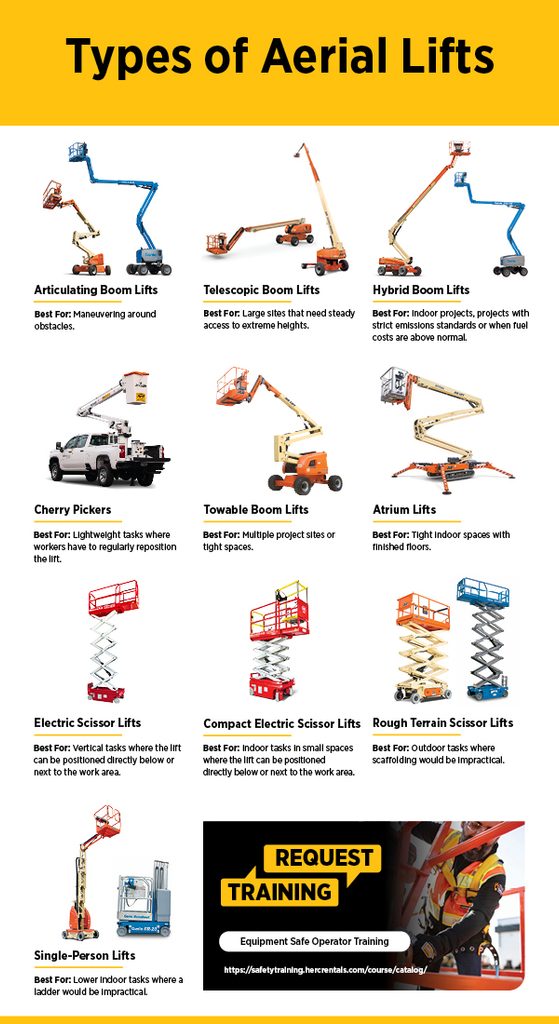
Not every lift is built for the same job. Some lifts reach extreme heights; others bend around obstacles. Some are designed for tight indoor spaces or rough outdoor terrain. You’ll find options that run on electric power for quiet, sensitive environments. You can also find diesel- or gas-powered lifts for heavy outdoor work, compact designs for narrow aisles, and towable models for easy transport.
Each type has unique strengths and common applications. Choosing between types of lifts for construction starts with understanding what the work demands.
Articulating Boom Lifts
Articulating boom lifts are great for jobs that need precise positioning. Their jointed arms let workers reach up, over, and around tight or complicated spaces on construction sites, industrial facilities, and outdoor maintenance areas.
Articulating boom lifts are versatile too, with models available in two‑ or four‑wheel drive and electric, hybrid, diesel or gas power. Their rotation helps crews handle tricky tasks safely and efficiently.
- Best For: Maneuvering around obstacles.
Telescopic Boom Lifts
Some jobs don’t require reaching around tight spaces; they just need steady height. When crews are installing piping or wiring in a new manufacturing facility, a telescopic boom lift is often the right choice. Its wide base adds stability at extreme heights, which is especially helpful on sites with loose dirt or gravel. That extra strength and reach make it a reliable option when the work calls for lifting heavier materials.
- Best For: Large sites that need steady access to extreme heights.
Hybrid Boom Lifts
Some jobsites make getting fuel slow, inconvenient, or even unsafe. A hybrid boom lift helps the work keep moving by switching to electric power when fuel isn’t easy to reach. Even when access isn’t the issue, fuel costs can cause projects to run over budget. Hybrid models offer many of the same strengths as gas‑powered lifts, including the ability to handle bumpy terrain that would be risky for equipment with a smaller ground base.
- Best For: Indoor projects, projects with strict emissions standards or when fuel costs are above normal.
Towable Boom Lifts
Large boom lifts usually arrive on a tractor-trailer, but not every jobsite has space to receive equipment that large. Tight entrances, narrow access roads or crowded work areas can turn a simple delivery into a delay or even a safety risk. Towable boom lifts help avoid those problems. Their compact design makes them easier to position while still giving crews the height and power they need to get the job done.
- Best For: Multiple project sites or tight spaces.
- Read more: How to Tow a Boom Lift Safely
Cherry Pickers
Not every boom lift needs a tractor trailer delivery. Cherry pickers, also called a bucket truck, come with their own transportation because the lift is mounted directly to a utility truck. They’re common in emergency services, utility repairs, forestry, agriculture and even event setup. Different models are built for different needs. One might handle swampy or uneven ground while another is designed to protect workers from electrical hazards.
- Best For: Lightweight tasks where workers have to regularly reposition the lift.
Atrium Lifts
Every person in charge of hanging or maintaining curtains, wall treatments, ceiling-mounted light fixtures, or sound systems in an event center needs equipment that can reach high spaces but still fit through a regular pedestrian doorway. Atrium lifts, sometimes called a spider lift, are built for exactly that.
Their compact, lightweight design lets them move through tight indoor areas without damaging floors. Different models offer features like non‑marking tracks or the ability to work both indoors and outdoors, making them useful for many kinds of setup and maintenance work.
- Best For: Tight indoor spaces with finished floors.
Electric Scissor Lifts
Electric scissor lifts are built for indoor projects that need both height and strength. Because they run on battery power, they’re a good choice in places where fumes or loud engines could create safety issues. They can reach working heights up to about 45 feet, making them useful for jobs like changing ceiling lights, repairing HVAC units or running cables across tall beams in a data center. Even with their larger size, they help crews work safely and efficiently indoors.
- Best For: Vertical tasks where the lift can be positioned directly below or next to the work area.
Compact Electric Scissor Lifts
When a jobsite is indoors and tight on space, a compact electric scissor lift can help crews work safely, creating an access path. These lifts are battery powered and lightweight, so they don’t create fumes or loud engine noise. They’re useful for maintenance in schools, gyms and small retail stores, and they can fit through narrow aisles in warehouses or manufacturing facilities. Because they can travel in elevators and reach up to about 26 feet, even multi‑level buildings become workable jobsites with a compact scissor lift.
- Best For: Indoor tasks in small spaces where the lift can be positioned directly below or next to the work area.
Rough Terrain Scissor Lifts
Anyone who’s spent time working outdoors knows the terrain has to be part of any solid job hazard analysis (JHA). Soft soil, dips and exposed roots can all create hazards that aren’t easy to eliminate. When the ground itself becomes the challenge, a rough terrain lift is a type of construction aerial lift that can add ease to difficult tasks. These lifts are built to stay stable on uneven surfaces, with potential features like oscillating angle systems and non‑skid decks that help prevent tipping even when the terrain is bumpy or unpredictable.
- Best For: Outdoor tasks where scaffolding would be impractical.
Single-Person Lifts
As the name suggests, single-person lifts are built for one worker and help keep a one-person job simple. Their smaller, energy efficient designs are often made to be pushed from place to place, making setup quick and easy. They’re great for indoor maintenance tasks like warehouse shelving installation, light replacement, or painting. These lifts help keep straightforward jobs safer and more efficient, since an engineered solution like this is still a better choice than scaffolding or ladders when tools and materials need to be lifted.
- Best For: Lower indoor tasks where a ladder would be impractical.
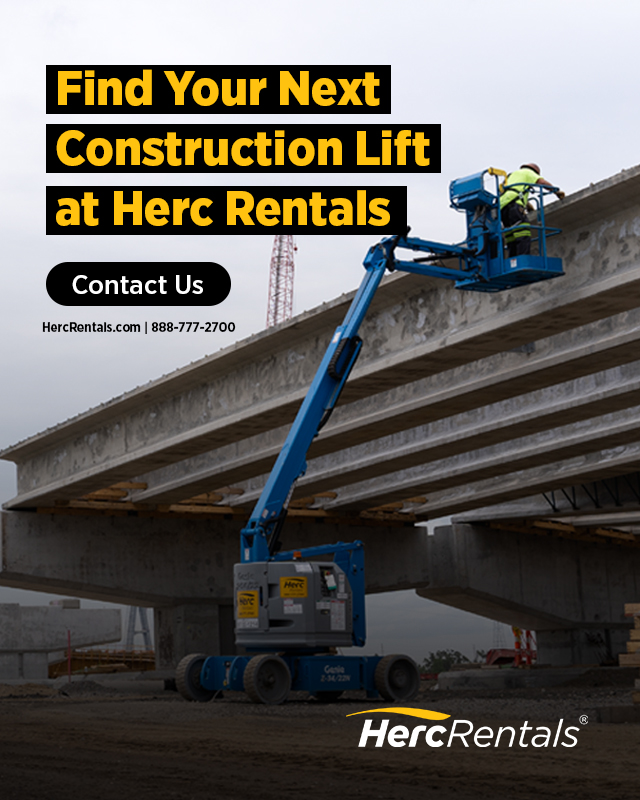
Take Your Project to New Heights with High-Quality Aerial Lifts from Herc Rentals
The right construction boom lift or other aerial lift can make a variety of elevated jobs safer and more efficient. Whether your next construction project is indoors, outdoors, on smooth surfaces, or on bumpy ground, there’s a lift designed to match your project’s needs.
At Herc Rentals, we can help you choose the best option for your team, with reliable equipment and expert guidance. Browse our wide selection of aerial lifts or contact a local branch to request a quote at 1-800-432-6215.