Last Updated on October 28, 2026
When a project requires workers, tools and materials to reach elevated areas, choosing the right access equipment can improve efficiency, productivity and safety. Scissor lifts are among the most widely used aerial work platforms across industries, including construction, warehousing, utilities, healthcare, education and entertainment.
Whether a crew is replacing exterior lighting, repairing HVAC systems or retrieving inventory from high storage racks, scissor lifts provide a stable, elevated platform for a variety of tasks.
Understanding the different scissor lift types, their key advantages and the applications they support can help you determine when this equipment is the right fit for your project.
Advantages of Scissor Lifts
Scissor lifts are a type of mobile elevated work platform (MEWP). Their name comes from the crisscrossed supports beneath the platform that expand and contract like a pair of scissors to raise and lower workers, tools and materials.
Unlike boom lifts, which can extend outward and reach over obstacles, scissor lifts are designed primarily for straight-up-and-down access. Their vertical electric lift design offers several advantages, including a spacious work platform and substantial capacity for lifting heavy loads of workers, tools and materials.
Many self-propelled models can travel around a project site with the platform lowered, including over ramps, helping crews move efficiently between work areas to complete repetitive tasks. When lowered, the scissor mechanism folds into a compact footprint for easier storage and transport.
Common Scissor Lift Applications
Scissor lifts are used across construction, facility maintenance, warehousing, utilities, retail and media-production environments. Their vertical reach, platform capacity and mobility make them a practical choice for many elevated tasks.
By providing stable access to hard-to-reach work areas and keeping tools and materials close at hand, scissor lifts can improve productivity and efficiency in applications such as the following tasks.
- Electrical Systems: Utility crews may use properly equipped scissor lifts to access elevated electrical components for inspections, maintenance and repair work. The platform provides room for workers, tools and equipment, helping crews work efficiently at height.
- Ceilings: Facility maintenance teams use scissor lifts to replace ceiling tiles, service cables and complete other ceiling-level repairs.
- Lighting: Electricians and maintenance personnel use scissor lifts to install, replace and repair overhead lighting in warehouses, schools, hospitals, retail stores and other facilities.
- HVAC: Technicians rely on scissor lifts to access ductwork, piping, vents and elevated equipment for inspections, maintenance and repairs.
- Painting: Contractors use scissor lifts to reach high walls and ceilings in commercial and industrial facilities while keeping paint, tools and supplies within reach.
- Signage: Crews use scissor lifts to install, repair and maintain signs on building exteriors and other structures while keeping tools, hardware and materials nearby.
- Construction: Construction teams performing framing, masonry, drywall, electrical and finishing work often use scissor lifts to access elevated areas. Workers can bring the tools and materials needed for the job directly to the platform.
- Warehousing and retail operations: Indoor scissor lifts help workers retrieve inventory from high storage areas, install shelving and perform maintenance above aisles and sales floors.
- Filming and media production: Production crews use scissor lifts to position cameras, lighting, backdrops and personnel at elevated locations for film, television, photography and live events.
Types of Scissor Lifts and Their Uses
Scissor lifts are generally divided into two main categories: electric slab lifts for smooth, level surfaces and rough-terrain lifts for outdoor or uneven conditions.
Electric Scissor Lifts
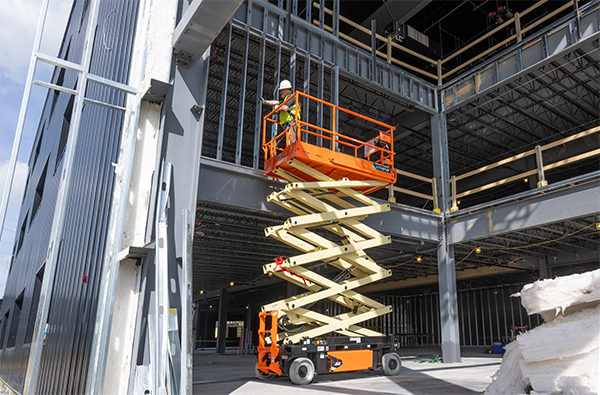
Electric scissor lifts are battery-powered machines designed primarily for indoor work on firm, level surfaces. They operate quietly and produce zero on-site emissions, making them ideal for warehouses, manufacturing facilities, retail stores, schools, hospitals and office buildings.
Compared to rough-terrain models, electric scissor lifts are generally lighter, more compact and easier to maneuver through hallways, doorways and other indoor spaces. Many feature non-marking tires to help protect finished floors. They provide ample platform space for maintenance, electrical work, lighting installation, inventory management and other overhead applications.
Their limitations are primarily related to terrain and capacity. Electric slab lifts are not intended for uneven, soft, muddy or significantly sloped ground, and platform capacities vary by model. Operators should also ensure the tires are appropriate for the floor surface.
Electric scissor lifts are best when quiet, zero-emission operation and efficient indoor performance are the primary requirements.
- Read more about sustainable efforts and zero-emission operation:
Compact Electric Scissor Lifts
Compact electric scissor lifts offer the same zero-emission, quiet operation as standard electric models but in a smaller package. They are a strong choice for narrow aisles, retail environments, maintenance rooms, office buildings and other locations where space is limited.
One of their biggest advantages is their small footprint. Mini scissor lifts can navigate tight work areas more easily and often fit inside passenger or freight elevators, making transportation between floors much simpler in multi-story buildings.
The tradeoff for their size is usually a smaller platform, lower lift capacity and reduced working height than larger electric or rough-terrain models.
Compact electric scissor lifts are best when indoor accessibility, tight-space maneuvering and easy movement between floors are top priorities.
Rough Terrain Scissor Lifts
Rough-terrain scissor lifts are designed for outdoor construction, maintenance and industrial work, with many models powered by diesel engines. They are built to handle uneven or challenging surfaces and typically feature heavy-duty, treaded tires. Many models also include four-wheel drive, positive traction systems or flotation tires to improve mobility on dirt, gravel, grass or sand.
Their larger design typically provides greater platform space, higher working heights and increased lifting capacities. Some models also include leveling outriggers to improve stability when conditions allow. Heavy-duty rough-terrain scissor lifts can support loads approaching 2,000 pounds, depending on the model.
However, their larger size, heavier weight and engine-powered operation make them less suitable for indoor environments, finished floors and occupied workspaces.
Choose a rough terrain lift when outdoor durability, traction, capacity and performance on uneven ground are the project’s primary requirements.
| Electric Scissor Lifts | Compact Electric Scissor Lifts | Rough Terrain Scissor Lifts | |
| Ideal Environment | Indoors Smooth pathways or rough terrain | Indoors Smooth pathways | Outdoors Rough terrain |
| Vertical Reach | 14-46 feet | 12-26 feet | 26-60 feet |
| Platform Size | 30-69 inches | 30-32 inches | 4+ feet |
| Weight Capacity | Up to 500 lbs. | Up to 500 lbs. | Up to 1,200 lbs. |
| Application | Various uses | Tight spaces | Large outdoor projects |
- Read more:
How to Choose the Right Scissor Lift
Scissor lifts can improve access, productivity and safety for elevated work, but only when the equipment matches the job. Before selecting a lift, consider the work environment, required height, platform size, load capacity and application.
1. Consider the Work Site Environment
Consider whether the lift will be used indoors or outdoors, as the work environment can affect which model is appropriate. Electric scissor lifts are generally best for smooth, level indoor floors, while rough-terrain models are designed for outdoor work on uneven ground. For finished floors, choose models with non-marking tires. Noise levels and emissions should also be considered, especially in occupied buildings.
2. Measure the Max Height Requirements
Determine the height of the work area and select a lift with sufficient platform and working height. Check for overhead obstructions such as beams, lights, sprinklers, pipes, ductwork and electrical lines before selecting and operating the lift.
3. Choose the Appropriate Platform Size
Choose a scissor lift platform large enough for the workers, tools and materials needed for the job. A larger platform provides more workspace, while compact models are better suited to narrow aisles, small rooms, doorways and other restricted spaces.
4. Estimate the Load Capacity Needed
Calculate the combined weight of workers, tools, materials and approved accessories that will be carried on the platform. Never exceed the lift’s rated capacity, which varies by model and configuration.
5. Consider the Specific Application and Safety Requirements
Finally, match the lift to the task and how workers will use it. Compact models are well suited to tight spaces and frequent movement between floors, while larger models offer additional platform space and capacity for demanding jobs. Also consider how often the lift will need to be repositioned and how easily operators can access the work area.
Safety should also be a factor in equipment selection. Always follow local safety regulations, such as OSHA’s recommendations, for assessing worksite hazards and ensuring only trained workers operate scissor lifts according to the manufacturer’s instructions.
Rent a High-Quality Scissor Lift from Herc Rentals
Scissor lifts provide a safe, efficient way to perform elevated work across a wide range of indoor and outdoor applications.
Whether you need a quiet, zero-emission electric scissor lift for facility maintenance, a compact model for navigating tight spaces and moving between floors, or a rough-terrain lift for challenging outdoor projects, choosing the right equipment can help crews work more efficiently.
Herc Rentals offers a wide selection of scissor lifts to meet different project requirements, including electric, compact electric and rough-terrain models with varying platform heights, capacities and features.
Browse our inventory of scissor lifts and other MEWPs to find the right equipment for your next project, or contact our team at 1-800-432-6215 for assistance choosing the right fit for your application.