Last Updated on October 28, 2026
If you work in construction, maintenance, utilities or warehousing, you will eventually need equipment to reach elevated work areas or to complete tasks at significant height. Few pieces of equipment handle this task better than boom lifts and scissor lifts.
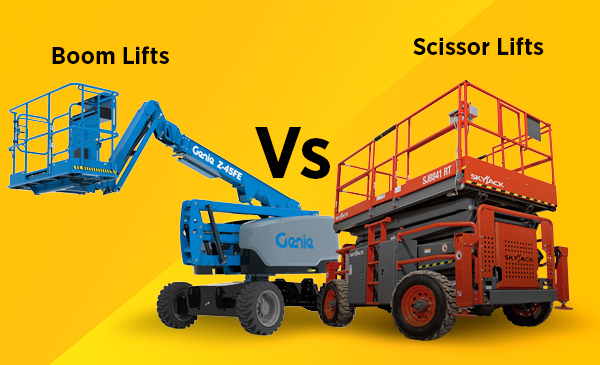
Boom lift vs. scissor lift – how do you decide which is a better fit for your project?
While both elevate workers, tools and materials, they are designed for different applications. Boom lifts can move vertically and horizontally, allowing operators to reach over obstacles and access hard-to-reach areas. Scissor lifts move straight up and down but offer larger platforms that can accommodate multiple workers and a heavier load.
Understanding these differences can help you choose the right equipment for your project.
What Are Boom Lifts?
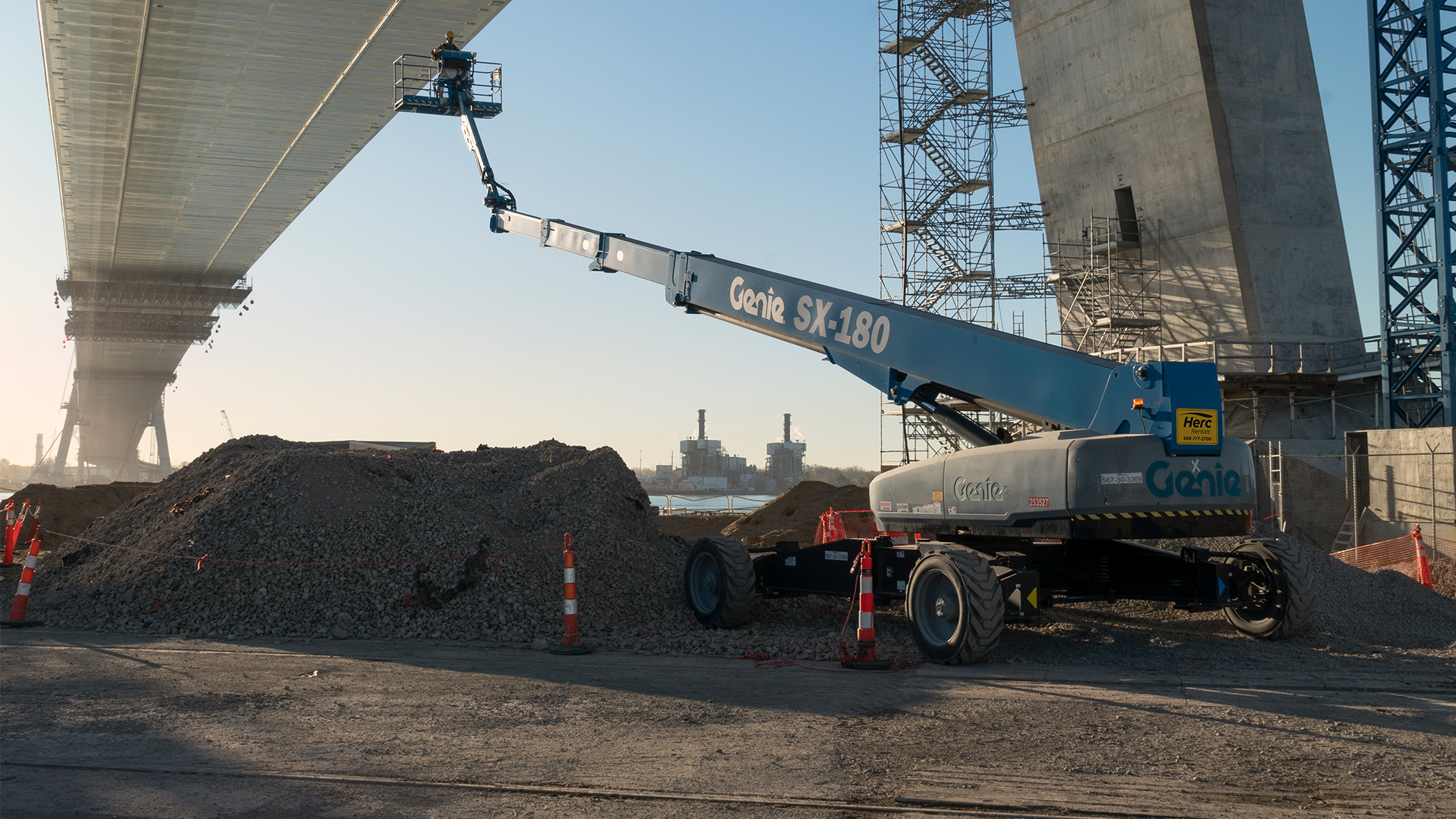
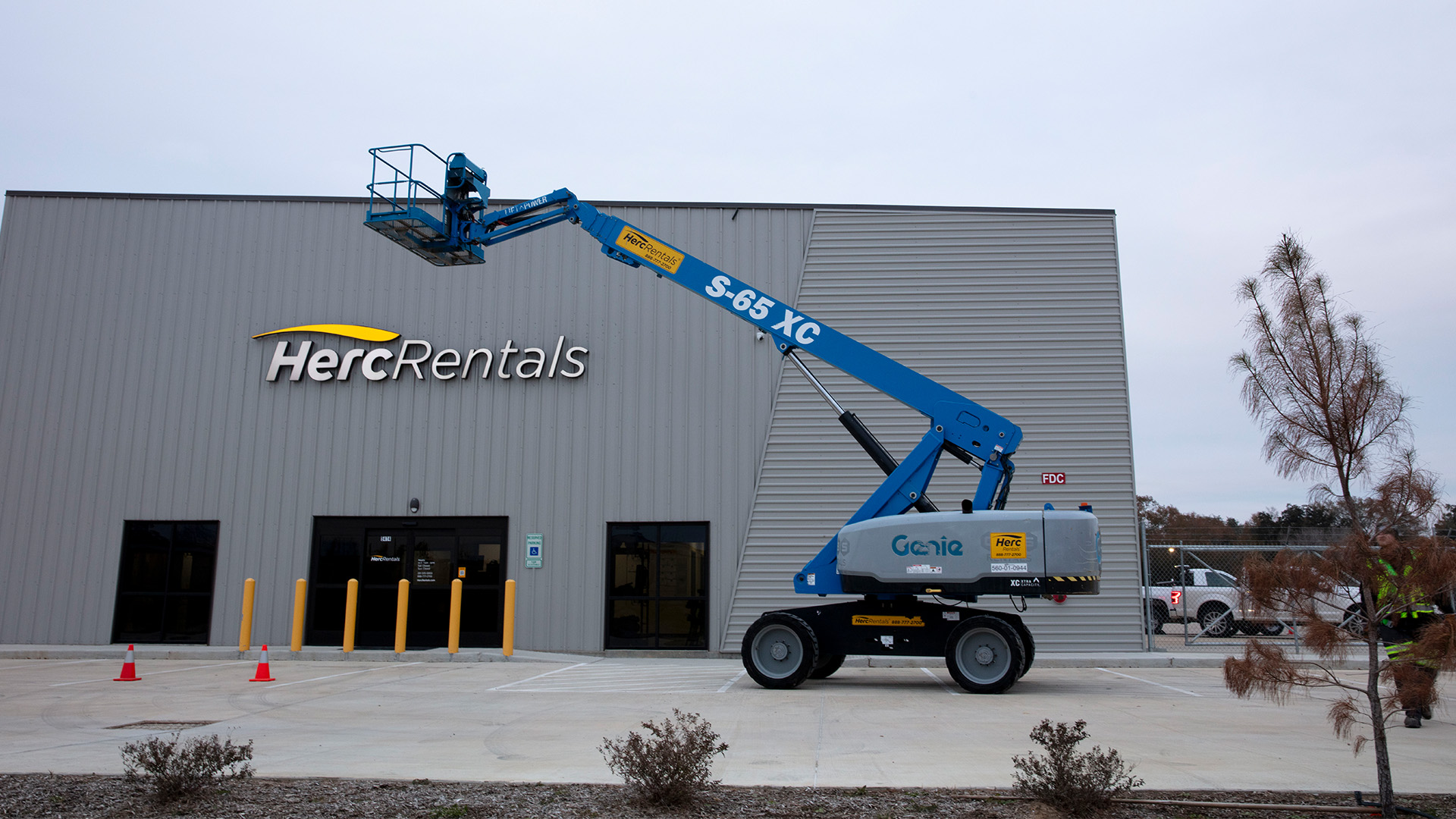
A boom lift is a type of aerial lift that uses a hydraulic arm, or boom, to raise workers, tools and materials to elevated areas in a bucket or small platform attached to the end of the boom. Boom lifts are also known as man lifts or cherry pickers.
What sets a boom lift apart from other aerial lifts is its ability to move both vertically and horizontally. The extended arm allows workers to access elevated work areas without being directly underneath them.
- Learn More: Boom Lift Basics: What You Should Know
Advantages of Boom Lifts
While they typically come with a higher price tag and smaller platforms than scissor lifts, boom lifts offer several advantages.
Their greatest benefit is their vertical and horizontal reach. They can reach greater heights and extend outward, allowing workers to access areas that would be difficult or impossible with only a vertical lift.
The hydraulic boom also provides greater maneuverability. Depending on the model, it can rotate, extend or articulate around obstacles. Some models offer 360-degree rotation, giving operators greater flexibility on the project site.
Boom lifts can also be useful for hard-to-reach or tight spaces. Their ability to position the platform precisely can reduce the need to reposition the entire machine, improving efficiency.
Boom lifts generally work best for one- or two-person jobs with limited tools and materials.
Common Boom Lift Applications
Common uses include:
- Building maintenance, repair and inspection
- Exterior cleaning, painting, roofing and façade work
- Scaffolding, bridge and high-rise maintenance
- Sign, lighting and traffic-signal installation
- Electrical, utility and telecommunications work
- Tree trimming, forestry and orchard work
- Warehouse, industrial and media-production work
Different Types of Boom Lifts
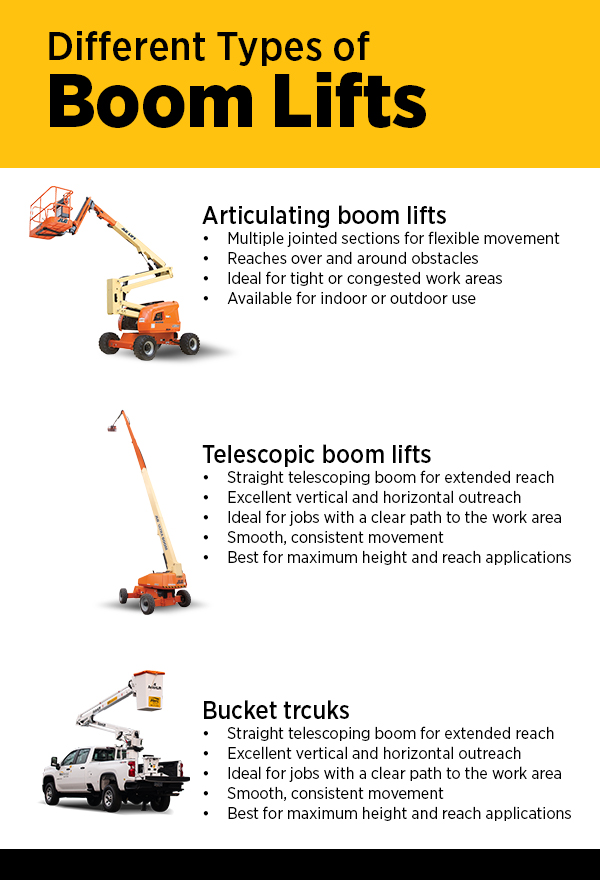
There are three common types of boom lifts: articulating boom lifts, telescopic boom lifts and bucket trucks.
- Articulating boom lifts have multiple jointed sections that bend like joints in an arm. This design allows the platform to move over and around obstacles, making them particularly useful when space is limited or the work area is congested. Articulating boom lifts’ flexibility also allows for precise platform placement. Depending on the model, they can be used indoors or out.
- Telescopic boom lifts use a straight arm that extends and retracts like a telescope. They offer substantial height and horizontal reach, making them well suited for projects with a clear path between the machine and work area. Their straight-boom design provides consistent movement and is often preferred when maximum height or outreach is the priority.
- Bucket trucks combine a truck with an elevated platform mounted to a hydraulic boom. Because the lift is integrated with the vehicle, it can easily travel between work locations. This makes bucket trucks particularly convenient for crews that need to perform similar elevated tasks at multiple sites.
What Are Scissor Lifts?
A scissor lift is a mobile elevated work platform supported by a series of crisscrossed braces that open and close like a pair of scissors. As the braces move inward, they extend vertically to raise the platform. When they move apart, the platform lowers.
Unlike boom lifts, scissor lifts move only straight up and down. Their large work platforms provide ample space for workers, tools and materials, making them ideal when the work area is directly above the machine.
- Learn More: How a Scissor Lift Works
Advantages of Scissor Lifts
While scissor lifts offer less reach and maneuverability, they provide several important advantages.
One of the biggest benefits is platform size. Their larger platforms may accommodate multiple workers and provide additional space for tools and materials, helping crews work more efficiently.
Scissor lifts also typically have higher weight capacities than boom lifts, making them well suited for tasks that require heavier loads. Their wide base and vertical lifting design create a stable work platform when used on firm, level surfaces and within rated operating limits.
Another advantage is versatility. Electric models are commonly used indoors because they operate quietly and produce no direct emissions, while rough-terrain and diesel models are designed for outdoor sites and uneven ground.
In many cases, scissor lifts also cost less to rent, purchase and operate than boom lifts, making them a cost-effective choice when horizontal outreach is not required.
Common Scissor Lift Applications
Common uses include:
- Warehousing and retail operations
- Building maintenance and repairs
- Construction and installation projects
- Interior finishing, painting, masonry, bricklaying and ceiling work
- Electrical, lighting and HVAC work
- Loading and unloading
- Material handling and transportation
Types of Scissor Lifts
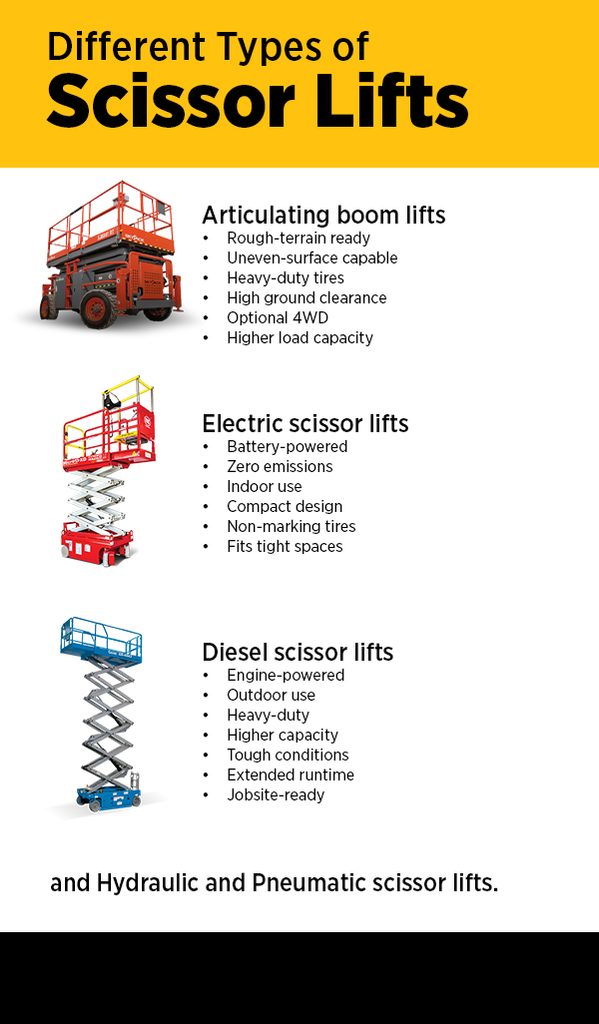
Scissor lifts are available in several configurations, including rough-terrain, electric, diesel, hydraulic and pneumatic models.
- Rough terrain scissor lifts are made for outdoor use on uneven or unpaved surfaces. They typically feature heavy-duty tires, additional ground clearance, and, in some cases, four-wheel drive. Their rugged construction allows them to handle more demanding conditions, while larger platforms and higher capacities can accommodate multiple workers and heavier loads.
- Electric scissor lifts are battery-powered, quiet and produce no direct emissions. They are usually used indoors on smooth, level surfaces where noise and emissions need to be minimized. Compact models can fit through narrow spaces and in some cases, elevators, making it easier to move equipment between floors. Non-marking tires are also available for applications where floor protection is important.
- Diesel scissor lifts are engine-powered machines built primarily for outdoor use. They provide the power and durability needed for demanding project sites and often offer higher platform capacities than electric models. They are a practical choice when extended operation, greater capacity or performance in challenging conditions is needed.
- Hydraulic scissor lifts use pressurized hydraulic fluid to raise and lower the platform. This system provides smooth, controlled movement and is widely used because of its reliability, lifting power and relatively straightforward operation.
- Pneumatic scissor lifts use compressed air rather than hydraulic fluid to power the lifting mechanism. They produce no direct emissions and can be an economical option for smaller projects or environments where hydraulic fluid leaks are a concern. Their simple power source can also make them suitable for applications with specific cleanliness requirements.
What to Consider When Choosing the Best Lift
Choosing the right lift depends on the requirements of the project. While both a boom lift and scissor lift provide safe access to elevated work areas, evaluating the following factors before renting or purchasing equipment can help you choose the best fit for the job.
| Boom Lift | Scissor Lift | |
| Direction & Reach | Vertical, horizontal, and diagonal reach Can reach up and over if articulated | Vertical reach only |
| Platform & Weight Capacity | Usually a smaller platform, designed for 1-2 people* | Some models can have a wider platform for multiple people* |
| Location & Terrain | Rough terrain accessible* | Some models are designed for rough terrain Usually best for indoor use |
| Project Budget | Often pricier than scissor lifts* | Usually less expensive than boom lifts* |
*Depending on the model and/or rental terms. Ask your equipment rental provider for details.
Direction and Reach Requirements
Start by considering the vertical reach and horizontal distance workers need to cover. Scissor lifts are made for straight vertical access, making them ideal when the work area is directly above the machine. Boom lifts provide both vertical and horizontal reach, allowing operators to work over obstacles or access elevated areas from different angles. Telescopic and articulating boom lifts offer even greater flexibility for hard-to-reach locations.
Estimated Weight Capacity
Next, determine the combined weight of workers, tools and materials. Scissor lifts typically offer larger platforms and higher weight capacities, making them a better choice for projects that require multiple workers or a heavier load. Boom lifts generally support fewer people and less equipment. However, they provide superior access and maneuverability.
Work Site Location and Terrain
Project site conditions are another important consideration. Rough-terrain boom lifts and scissor lifts are designed for outdoor use on uneven ground, while electric models are often preferred indoors because they operate quietly and have no direct emissions.
Construction Project Budget
Finally, consider your budget. Scissor lifts are generally less expensive to rent or purchase than boom lifts. However, the lowest cost option is not always the most cost-effective. Selecting equipment that meets your project’s access, capacity and terrain requirements can improve productivity and reduce delays, ultimately delivering the best value.
Rent a Boom Lift or Scissor Lift from Herc Rentals
The best aerial lift is the one that meets your project’s reach, capacity and site conditions.
Whether you need the extended reach and maneuverability of a boom lift or the large platform and capacity of a scissor lift, choosing the right equipment can help your crew work efficiently, safely and profitably.
Herc Rentals offers a wide selection of rental equipment, including boom lifts and scissor lifts for a variety of indoor and outdoor applications, from maintenance and construction to warehousing and utilities.
The next time you’ll be renting an aerial lift, choose a reliable boom lift or scissor lift from the Herc Rentals’ fleet, or call 1-800-432-6215 to speak with a specialist today.