Last Updated on June 3, 2026
Imagine the hottest day of the year. Your climate control system is pushed past its breaking point and stops working. Thinking quickly, you rent a portable air conditioning (AC) unit to keep the facility at an acceptable temperature. It arrives quickly only for you to discover that the AC outlet plug is not compatible with your power supply. Now it’s too late, workers are being sent home, product will have to be tossed and business grinds to a halt.
This scenario is avoidable. When you understand your facility’s electrical system and the available AC outlet plug, you can quickly choose a spot cooler that will work as soon as it arrives.
In this article, you will learn how to assess your facility to make sure you can run a portable AC unit at your site.
Can Your Electrical Circuits Handle an Air Conditioner Plug?
Before you rent a plug-in AC unit, it’s important to understand how your electrical circuits work. Not only that, you must know how much they can handle. Spot coolers often have higher power requirements than other common equipment, such as lights and computers. Without proper planning, the breaker could trip if a portable AC unit is installed on an overloaded circuit. This would suddenly shutting down all equipment on that circuit.
If your building is like most, an electrical panel with circuit breakers distributes power throughout the facility. Outlets within the space are wired to those breakers to protect against an electrical overload condition on that circuit. In many commercial spaces, several 115 Volt outlets are wired into the same circuit, protected by one breaker.
Each breaker is rated at a maximum allowable amperage. When the circuit load exceeds the breaker amperage, the breaker trips and turns off power to the circuit.
For a portable AC unit, you may need a dedicated circuit. This means the spot cooler will be the only piece of equipment plugged into the circuit. At higher voltages, such as 230 Volt and 460 Volt, electrical receptacles are typically wired into a dedicated circuit, due to the relatively high-power requirements of equipment operating at a higher voltage.
Additionally, the plug-type for each AC unit is also going to look a bit different than, say, a lamp. The plugs are designed for a specific voltage and amperage in accordance with UL and CSA Standards, per the National Electrical Code. Your outlets (also known as receptacles) will need to match the plug style of your unit.
Beyond Portable the AC Outlet Plug: 7 Things to Know About Your Facility When Choosing a Spot Cooler
Before the next time you need to rent a portable AC unit, take a minute to understand your facility’s electrical system, or work with an equipment rental provider to help assess your needs and your space.
When you can answer the following questions, you’ll be able to select the best unit quickly and avoid costly delays and damage caused by an incompatible unit. Work with an electrician to answer the following questions and make sure your circuits are working safely.
1. Is the Portable AC Plug Type and Outlet Compatible?
Many people rent a portable AC unit only to discover that the plug won’t fit in any outlet. This mismatch is often the first clue that there’s a problem.
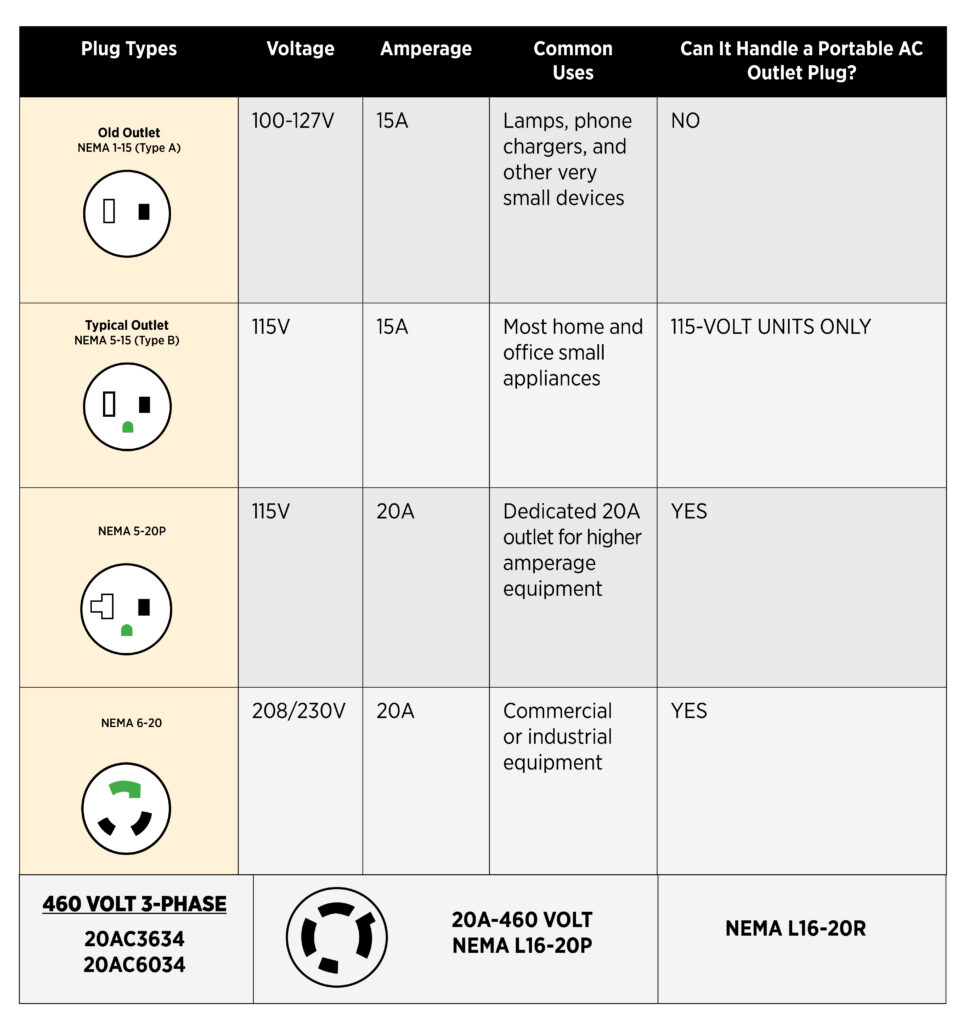
You’re likely familiar with regular two-pronged and three-pronged plugs and outlets. Two-pronged outlets (NEMA 1-15P) can be found in older homes and buildings, but three-pronged outlets (NEMA 5-15P) are now the most common typical outlets in most buildings.
There are many AC plug types available. Some portable AC units can work in a typical three-pronged outlet. However, more powerful portable AC units have plugs that require a different kind of outlet.
Compare the chart below to the outlets you have available. Make sure the unit you get has a compatible AC outlet plug, or have a new outlet installed that can handle the unit of your choice.
2. Is Your Building’s Voltage Compatible?
In the U.S., typical residential and commercial outlets are wired for 115 volts. While smaller AC units are capable of running using these outlets, most of them need around 230 volts with some of the largest options needing 460 volts.
Have a larger facility (like a warehouse), or one that needs more cooling power (like a data center)? You can have an electrician install a circuit and outlets rated for higher voltages.
3. What’s Your Facility’s Amperage Capacity?
Amperage measures how much power you can draw through a circuit. If you have ever plugged in too many appliances right near each other, you know what happens when the circuit can’t handle the needed amperage. The circuit breaker trips, and everything goes dark.
Portable AC units generally require between 3 and 14 amps. As long as they are not sharing a circuit with other appliances, you should have enough amperage to support them.
To keep from overloading a circuit, make sure you:
- Know how many amps the circuit can handle and how many amps the spot cooler needs.
- Know which electrical plugs and outlets are on the same circuit. If the circuit can handle the spot cooler but not much else, move equipment to another circuit and make sure your team knows which outlets to avoid plugging things into.
- Install a dedicated circuit, as needed, for the AC unit if using one is a frequent occurrence.
4. Does the Site Have Single-Phase or Three-Phase Power?
Portable AC units are available in both single and three-phase power configurations, so it’s important to understand what you have available at your facility.
Single-phase power is what is found in most homes and small commercial buildings. It consists of a live, or hot, wire that delivers the electrical current as well as a neutral wire that returns the current (completing the circuit). They sometimes have a third ground wire for safety.
Three-phase power is found in larger commercial and industrial facilities and is used because it can provide far greater power. It consists of three hot wires, one neutral wire, and sometimes a ground wire.
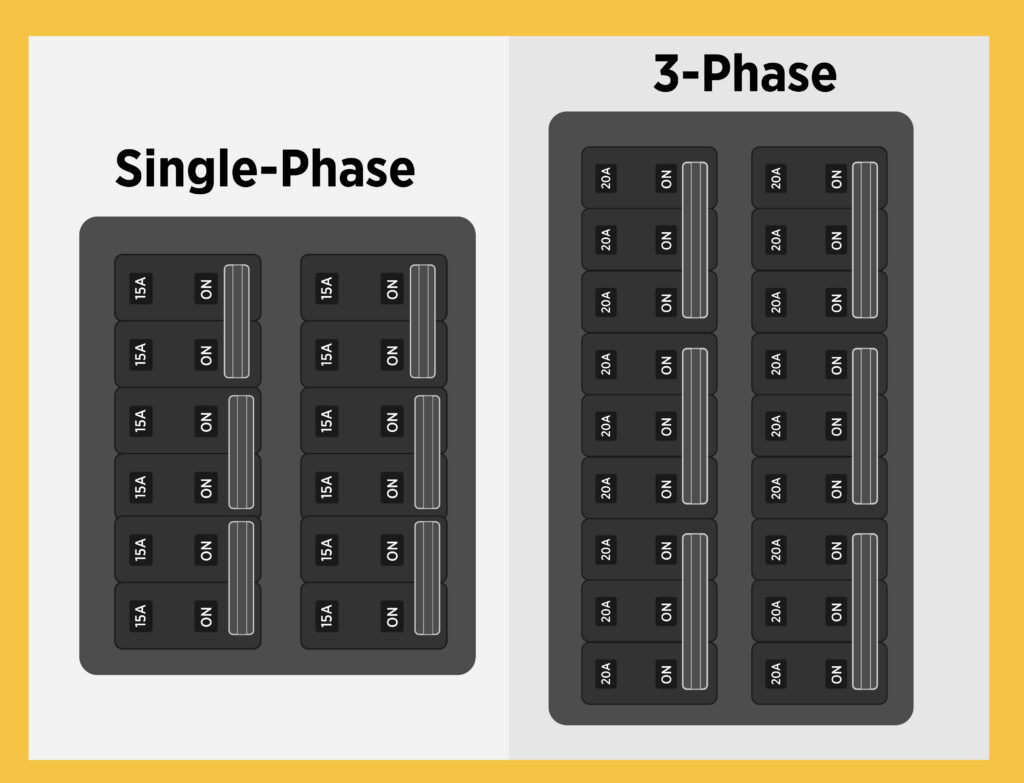
Look at your electrical panel to find out what type of power you have. If there are three to four wires leading into the top terminal and the main breaker is three switches long, it’s three-phase power. If there are only two wires leading into the panel, and the main breaker is only one or two switches long, it’s single-phase power.
5. Is There a Dedicated Circuit Available?
Some portable AC units require their own dedicated circuit. This setup prevents the unit from interfering with other electrical systems or overloading their circuits. It is especially important when there is sensitive equipment or limited electrical capacity available.
Turn an existing circuit into a dedicated circuit by removing all other appliances, lights and equipment from the circuit. Label the circuit and take other steps to ensure no one accidentally plugs something into the circuit while the portable AC unit is installed.
Alternatively, have a dedicated circuit installed. Make sure it can handle the voltage and amperage needs of the spot cooler you’re considering.
6. For Outdoor Use: Is the Site’s Electricity Compatible?
Outdoor portable AC units are not designed to be plugged into a typical outdoor circuit. When ordering an outdoor unit, take into account the same considerations as with indoor units, plus any grounding and weatherproofing measures they require.
Talk to your equipment rental provider and review the operator’s manual for specific requirements.
7. Are All Circuits Up to Code?
Whether it’s an old building or shoddy construction, some facilities’ electrical systems aren’t up to current building codes and electrical standards. Whether the outlet lacks a grounding wire, is improperly insulated or has the wrong size wires, electrical wiring that is not up to code can result in fire or electrical shocks, which are a danger to both your personnel, equipment and facility.
If you suspect these issues, have a professional electrical inspection done before you need a spot cooler to make sure everything is safe and functional.
Get Portable AC Outlet Plugs Right on the First Try with Herc Rentals
If your facility needs a portable AC unit but you’re unsure about your electrical infrastructure, the experts at Herc Rentals are here to help. Our trained specialists will perform on-site assessments to evaluate your cooling needs and electrical compatibility. Then, they’ll recommend the right spot cooler that will work with your electrical system.
Save yourself the frustration of mismatched equipment and costly delays. Visit Herc Rentals Climate Control Solutions to explore the full line of rental options and schedule a site visit with your local Herc Rentals online or by calling 1-800-432-6215.