Last Updated on June 25, 2026
Data center construction projects are surging nationwide, fueled by explosive growth in artificial intelligence (AI) and data-intensive technologies. Once a niche segment, data centers are now among commercial construction’s fastest-growing sectors.
For contractors, this growth of data centers and AI in construction means unprecedented opportunity. But data centers demand specialized infrastructure, aggressive schedules and mission-critical equipment that must perform without failure. Your project’s success depends on how well you understand the full construction lifecycle. It also depends on your ability to plan for data center equipment needs well in advance.
In this guide, you’ll learn about the data center construction management process, from site preparation through commissioning, and what rental equipment you may need to deliver projects on time and on budget.
What’s Fueling the Multi-Billion-Dollar Data Center Boom?
Data centers are no longer optional infrastructure. They are foundational for the modern economy. Rapid adoption of AI, Internet of Things (IoT) devices and enterprise cloud platforms have dramatically increased demand for computing power, data storage and low-latency connectivity.
Major players like Amazon, Google and Microsoft are investing billions annually in construction spending to expand data center campuses and regional facilities. According to McKinsey, “companies will invest almost $7 trillion in capital expenditures on data center infrastructure” by 2030.
For data center construction companies, this growth presents sizable opportunities, particularly for those who can master the specialized technical, power and scheduling demands unique to data center construction projects.
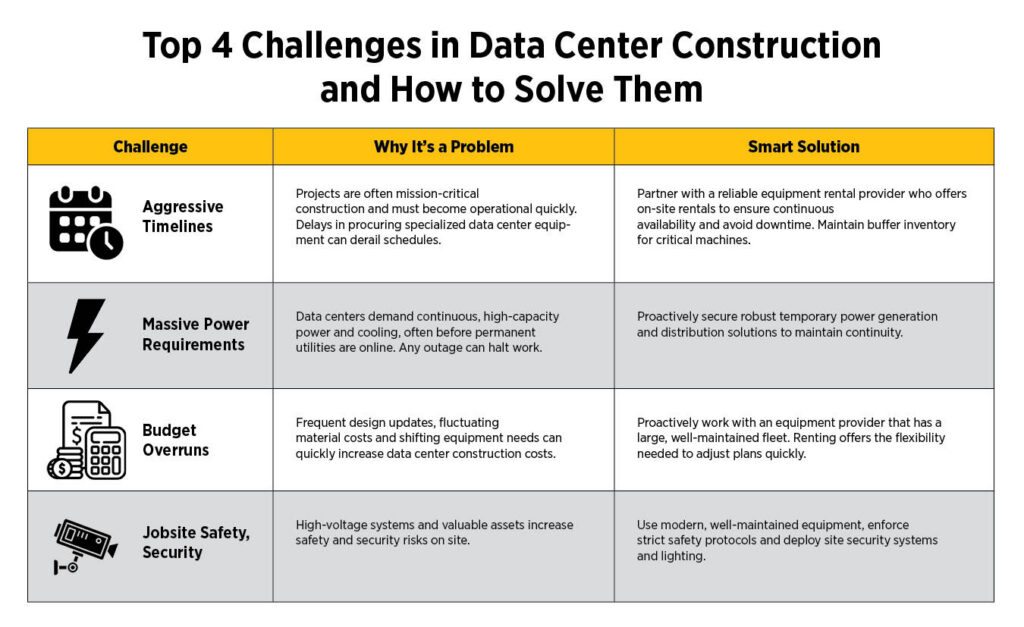
Top 4 Challenges in Data Center Construction and How to Solve Them
Data center construction poses unique challenges at every stage. With demanding schedules, specialized infrastructure and little margin for downtime, even minor setbacks can delay progress and increase data center costs per square foot. Here are four common challenges and practical ways to overcome them.
The 5 Phases of Data Center Construction and the Critical Equipment Needed
Data center construction spans five key phases, each with distinct technical demands and specialized equipment needs. Proactive planning and early procurement keep projects on schedule and budget. Integrate your equipment needs into the project’s design (not as an afterthought) and align with power availability, network readiness and other milestones to avoid costly delays.
Phase 1: Site Selection and Preparation
Site selection and preparation set the foundation for the entire project.
Data center projects need more infrastructure support than other commercial projects. If the site doesn’t have access to a robust electrical grid or a major fiber infrastructure, the project will likely involve building this infrastructure before work on the data center itself can begin.
Data centers also need a lot of space. These undertakings are often subject to extra zoning and permitting regulations to minimize their impact on the area around them. Environmental factors such as drainage, wetlands, noise control and emissions management must be addressed at this stage to prevent regulatory issues and schedule delays.
Physical site preparation begins with grading, clearing land, stripping topsoil and stabilizing the subgrade for structures, pads and access roads. Crews excavate foundations, underground utilities, duct banks, grounding grids and drainage to support later electrical and mechanical systems. Temporary power, construction access and staging areas are established during this phase to support ongoing work.
Key Tasks:
- Training teams on all required permitting, environmental protection, and safety regulations
- Site surveying and geotechnical testing
- Clearing vegetation and debris
- Mass grading and soil stabilization
- Excavation for foundations, utilities and infrastructure
- Installing grounding grids and erosion control measures
Possible Equipment Needed:
- Generators for power continuity
- Bulldozers for rough grading
- Excavators for trenching and digging
- Compactors for achieving soil density
- Dump trucks for hauling
- Water trucks for dust control and soil conditioning
Read more: 10 Safety Tips for Data Center Workers
Phase 2: Core and Shell Construction
With the site prepared, construction moves into core and shell work, where the physical structure of the data center takes shape. All parts of the structure need to support the unique needs of the sensitive equipment that the data center will house.
Crews begin by pouring concrete foundations and slabs designed for extreme static and dynamic loads.
Then the primary structural framework is erected, typically using steel or precast concrete to form columns, beams and floors. Exterior walls follow, often constructed using tilt-up concrete panels, precast systems or metal building components, depending on design and schedule requirements.
Roofing systems come next, with stringent thermal performance, moisture protection and wind-resistance standards. Loading docks, service entrances and secured access points are established during this phase. Exterior envelope work seals the shell against air and water while meeting fire-resistance and energy-efficiency standards. These steps create a weather-tight enclosure ready for interior and mechanical, electrical and plumbing (MEP) work to begin.
Key Tasks:
- Foundation placement and curing
- Structural framework erection
- Wall panel installation and sealing
- Floor and roof deck construction
- Loading dock and service area flatwork
- Exterior envelope completion
Possible Equipment Needed:
- Concrete mixers
- Cranes for structural lifts
- Boom lifts for wall and roof access
- Scissor lifts for interior framing
- Light towers for extended work hours
Phase 3: MEP Installation
Mechanical, electrical and plumbing (MEP) systems form the backbone of any data center, providing continuous power, cooling and reliability. Modern data centers are often equipped with servers drawing over 100 kilowatts per rack, generating massive heat that demands highly efficient cooling. MEP systems must be routed carefully through dense spaces, with redundancy required at every level.
This phase includes installation of primary power feeds, switchgear, transformers, uninterruptible power supply (UPS) and power distribution units (PDUs). Backup generators and fuel systems protect against grid failure. Mechanical rough-in follows with chillers, cooling towers, air handlers, piping, ductwork and environmental controls.
Temporary power supports construction and early system testing before permanent infrastructure is fully operational.
Key Tasks:
- Power infrastructure installation (transformers, switchgear, UPS)
- Generator and fuel system setup
- Cooling systems rough-in (chillers, piping, ductwork)
- Cable tray, conduit and busway routing
- MEP coordination and testing
Possible Equipment Needed:
- Industrial generators
- PDUs
- Cable pullers and wire management tools
- Temporary HVAC or climate control units
- Forklifts and lifts for heavy components
Phase 4: “White Space” and IT Infrastructure Fit-Out
With MEP systems in place, construction moves into the “white space,” where servers, storage and networking gear are installed.
Climate control is critical at this stage, because even brief spikes in temperature or humidity can damage high-value electronics. Coordination across electrical, mechanical and information technology trades ensure seamless integration, while strict cleanliness protects sensitive equipment.
Work begins with teams installing raised flooring to manage airflow and cabling. Heavy server racks, often exceeding 2,000 pounds fully loaded, are positioned along with overhead busways and containment systems to optimize cooling. Structured cabling connects racks to switches, PDUs and patch panels. Network gear and storage arrays complete the data hall. Precision matters as misaligned racks kill airflow and bad cable runs drop signals.
Key Tasks:
- Raised floors and containment systems installed
- Server racks installed and aligned
- Overhead busway and PDUs connected
- Structured cabling run
- Network gear integrated
Possible Equipment Needed:
- Scissor lifts and boom lifts for interior access
- Material lifts for rack positioning
- Compact forklifts for pallet maneuvering
- Pallet jacks for final rack placement
Phase 5: Commissioning and Go-Live
The final phase confirms the data center can perform under real-world conditions before going live. Load bank testing validates that the power and cooling systems can handle full capacity, failures and recovery. Integrated systems testing simulates outages, load spikes and concurrent failures to verify mission-critical resilience.
Teams run load banks to stress electrical systems at 100% capacity, verifying the performance of switchgear, UPS systems and backup generators. Cooling tests push computer room air conditioning units and chillers to extremes while monitoring airflow, temperature and humidity. Fire suppression, security and building management systems are also tested to confirm proper sequencing and response.
Once all systems pass their tests, the data center officially opens for business.
Key Tasks:
- Load bank testing
- Generator/UPS failover simulations
- Cooling system stress testing
- Integrated systems testing
- Final documentation and owner training
Possible Equipment Needed:
- Load banks for power testing
- Backup generators for redundancy
- Specialized monitoring equipment
- Supplemental cooling solutions
Build the Future with Herc Rentals
In today’s world, computing may end in the clouds, but it starts on the ground with advancing data center construction. Amid booming construction trends, this market offers growth potential for years to come.
From early site work through final commissioning, the right equipment ensures seamless execution and maximum uptime for these high-stakes facilities.
That’s where Herc Rentals comes in. With an extensive fleet of well-maintained, job-ready equipment, flexible rental options and knowledgeable specialists, Herc Rentals is equipped to support the unique demands of data center construction projects.
Explore the full equipment guide, or connect with a Herc Rentals expert to find solutions for your project by calling 1-800-432-6215 today.